Guide to 1099 compliance for work with athletes, agencies, and collectives

Let’s say your organization pays hundreds of athletes, esports participants, creators, and contractors in the U.S. and abroad.
Many of these payments are covered by Forms 1099-NEC and 1099-MISC and become reportable once they reach $2,000 during the calendar year. The right form depends on the payee, payment type, and payment method. Payments to foreign persons follow separate reporting and withholding rules.
Late, missing, or incorrect information returns can lead to separate penalties for the return filed with the IRS and the statement furnished to the payee. The amount depends on how late the correct information is provided. Intentional disregard carries a higher penalty with no overall maximum.
In this article, we focus on 1099 compliance for sports rights holders, esports, collectives managing student athletes (NIL), and talent agencies paying global content creators. But the same reporting framework applies to any U.S.-based business that pays contractors or other non-employees.
Brushing up on 1099 basics
Form 1099 is a family of information returns used to report specific types of payments.
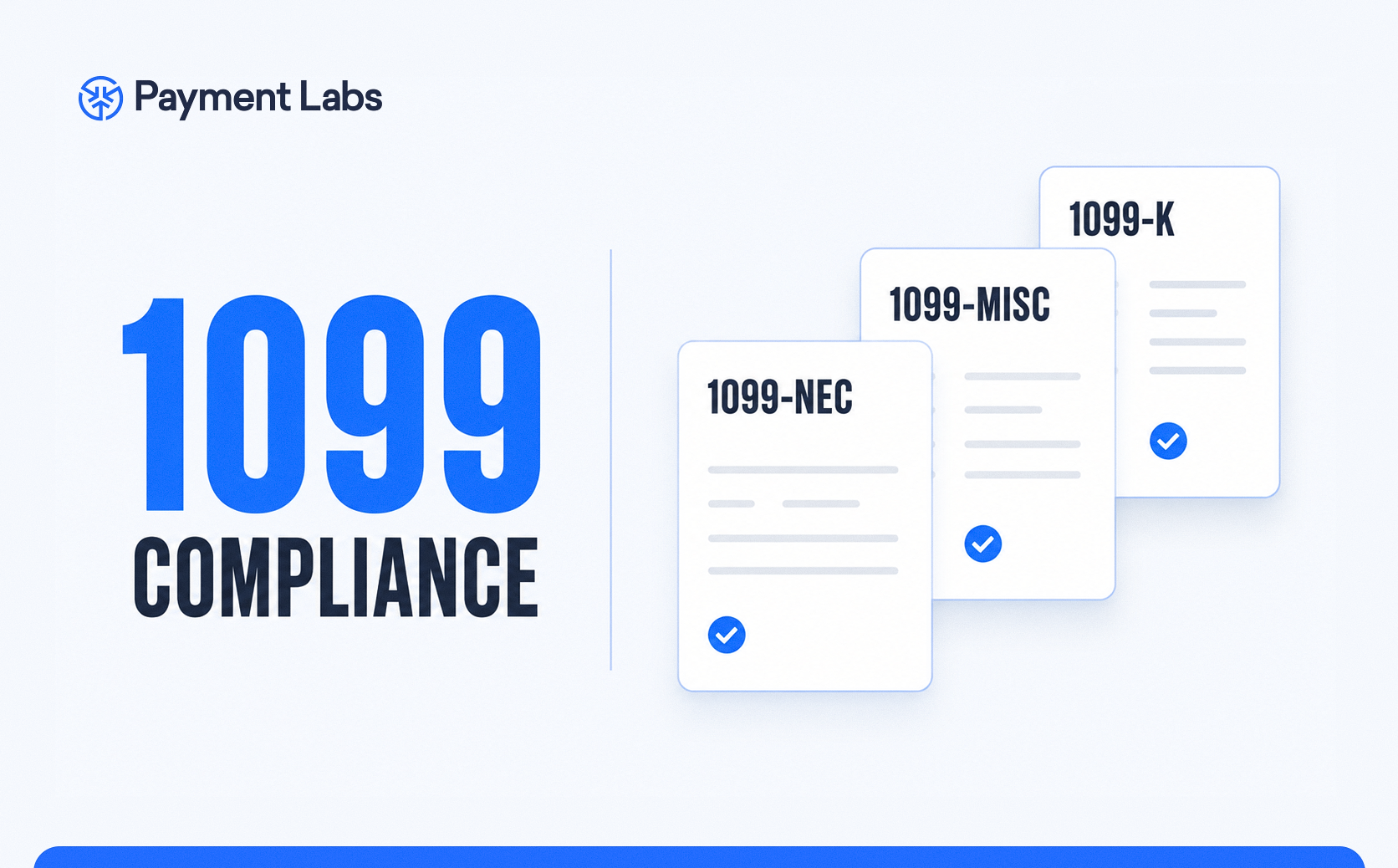
- Businesses must report at least $2,000 in non-employee compensation paid to a reportable U.S. payee on Form 1099-NEC.
- Form 1099-MISC covers at least $2,000 in rents, prizes, awards, and certain other payments, while royalties remain reportable at $10.
- Payments handled through cards or qualifying third-party networks are reported separately on Form 1099-K by the payment settlement entity.
- Payments to foreign persons follow the applicable Form W-8 and Form 1042-S rules.
Collect the tax forms during onboarding, before payments begin. This allows the payer to verify the payee’s tax status and TIN and track reportable payments throughout the year. The deadlines for filing your 1099s for the new year are:
- Form 1099-NEC - furnish the payee statement and file with the IRS by January 31.
- Form 1099-MISC - generally furnish the payee statement by January 31. File with the IRS by February 28 on paper or March 31 electronically.
- Electronic filing - businesses filing 10 or more information returns in total must file electronically.
When a deadline falls on a weekend or legal holiday, it moves to the next business day.
How to prepare for filing Forms 1099 and 1042-S to avoid penalties and fines
The process differs for U.S. and foreign payees.
- Collect Form W-9 from a U.S. payee to document their name, federal tax classification, and TIN.
- Collect the appropriate Form W-8 from a foreign payee to establish foreign status and document any treaty benefits that apply to the payee.
When a reportable U.S. payee fails to provide a certified TIN or when the IRS instructs the payer to begin withholding after a name-and-TIN mismatch, a payer must apply 24% backup withholding.
Here is an example of the domestic and international processes:
- U.S. contractor:
- You pay a U.S. creator at least $2,000 for services during a calendar year.
- The creator completes Form W-9 before payment.
- You use the Form W-9 and payment records to prepare Form 1099-NEC.
- You deliver the form to the payee and file it with the IRS by January 31 of the following year.
- Foreign contractor:
- Collect the appropriate Form W-8 to establish the payee’s foreign status and any claimed treaty benefit.
- Determine whether the payment is U.S.-source. For services, the source generally depends on where the work is performed.
- Apply U.S. withholding only when required, using any applicable exemption or treaty rate.
- Report qualifying payments on Form 1042-S by March 15 of the following year.
For a mixed payee population, collect Form W-9 from each U.S. person and the appropriate Form W-8 from each foreign person. Use the payee’s status, payment type, and place of performance to determine reporting and withholding.
Penalties and fines for 1099-related tax violations
The IRS applies separate penalties for filing an incorrect or late information return and for furnishing an incorrect or late payee statement. For information returns:
- The penalty is $60 per return when the correct return is filed within 30 days after the deadline.
- The penalty is $130 per return when it is filed more than 30 days late but by August 1.
- The penalty is $340 per return when it is filed after August 1 or not filed.
- Intentional disregard carries a minimum penalty of $680 per return, with no overall maximum.
The same schedule applies separately to late or incorrect payee statements. Annual maximums apply to the first three tiers and differ based on business size.
Types of 1099s and their deadlines
There are more than 20 types of Forms 1099 covering different payments and transactions – from dividends and real estate transactions to government and pension payments.
Let’s look at the most common ones and those that apply most commonly to the businesses in our focus of attention.
- 1099-NEC reports non-employee compensation. It applies when a business pays at least $2,000 for services to a reportable U.S. payee. This includes athletes, coaches, trainers, referees, and other non-employees when they are paid for services. Furnish the form to the payee and file it with the IRS by January 31.
- 1099-MISC reports royalties of at least $10 and rents, prizes, awards, and certain other payments of at least $2,000. Generally furnish the payee statement by January 31.
- 1099-K reports qualifying card and third-party network transactions and is filed by the payment settlement entity. Payment-card transactions are reportable regardless of amount. For third-party settlement organizations, reporting is generally required when payments exceed $20,000 across more than 200 transactions.
These thresholds and deadlines are crucial for businesses to track, as failure to issue the appropriate 1099 forms can lead to the penalties we went over before.
How to automate this process
Manual tax-form collection and year-end reconciliation leave teams chasing missing forms, resolving TIN mismatches, reconstructing payment totals, and correcting records as filing deadlines approach.
Payment Labs collects and validates Forms W-9 and W-8 during onboarding, tracks reportable payments by payee, applies required withholding, and generates and delivers the applicable tax forms. Tax reporting remains connected to the same records used to onboard and pay each recipient.
Here is what clients say about Payment Labs’ effect on their tax and compliance work:
- “Keeping current on tax requirements worldwide is a challenging process that Payment Labs’ platform made approachable.”
— Rick Thiher, General Manager, EVO
- “Gone are the days of worrying about compliance and year-end tax reports.”
— Laurent Genin-Satoh, Managing Director, LiquidDogs
- “Payment Labs saved us during tax season. Payment Labs is a service we absolutely need.”
— Chris Heiman, President and Co-Founder at MediaNug
- “This platform has saved us time and hassle, even allowing us to automate our tax compliance.”
— Brent LaLonde, Arnold Sports Festival Event Organizer
Payment Labs specializes in compliant cross-border and domestic payment processing at scale. Our clients include sports rights holders that pay vendors, event contractors, referees, scorekeepers, and prize winners, collectives that pay hundreds of student-athletes for their name, image, and likeness (NIL), and talent agencies that pay creators, streamers, and influencers worldwide.
Whether you’re in one of these industries or not, we have an intuitive solution to address your business's specific payment processing needs. Schedule an intro call to see how Payment Labs can reduce the time and work involved in tax reporting for your organization and its payees.