How to avoid IRS penalties when filing Forms 1099 and 1042-S for your business
Learn to manage Forms 1099 and 1042-S across domestic and international payouts, from tax form collection and payment classification to withholding, filing deadlines, common errors, and IRS penalty risk.

A single reporting mistake is usually fixable. The real problem starts when the same issue repeats across hundreds or thousands of Forms 1099 or 1042-S. For businesses paying athletes, prize winners, contractors, creators, agencies, or international recipients, payout volume can turn small tax reporting errors into real tax compliance exposure.
That exposure usually starts before filing. A missing W-9, incomplete W-8, incorrect TIN, misclassified payment, missed deadline, or wrong withholding decision can create more manual work, delay recipient reporting, and increase the chance of IRS penalties.
If you work with U.S. payees or pay U.S.-source income to foreign recipients, you need a controlled process for collecting tax documentation, classifying payments, tracking withholding, filing with the IRS, and furnishing recipient copies on time.
In this article, we’ll cover how Forms 1099 and 1042-S work, which forms apply to common payout scenarios, key filing deadlines, common classification mistakes, IRS penalty tiers, and how businesses can reduce risk when managing domestic and international payouts.
Quick answer: how businesses avoid 1099 and 1042-S penalties
Businesses reduce 1099 and 1042-S penalty risk by collecting tax forms before payment, validating payee details, classifying each payment correctly, tracking withholding, filing with the IRS on time, and sending recipient copies by the required deadline. The more recipient types a program has, the harder it is to keep forms, withholding decisions, and payout records aligned.
Understanding Forms 1099 and 1042-S
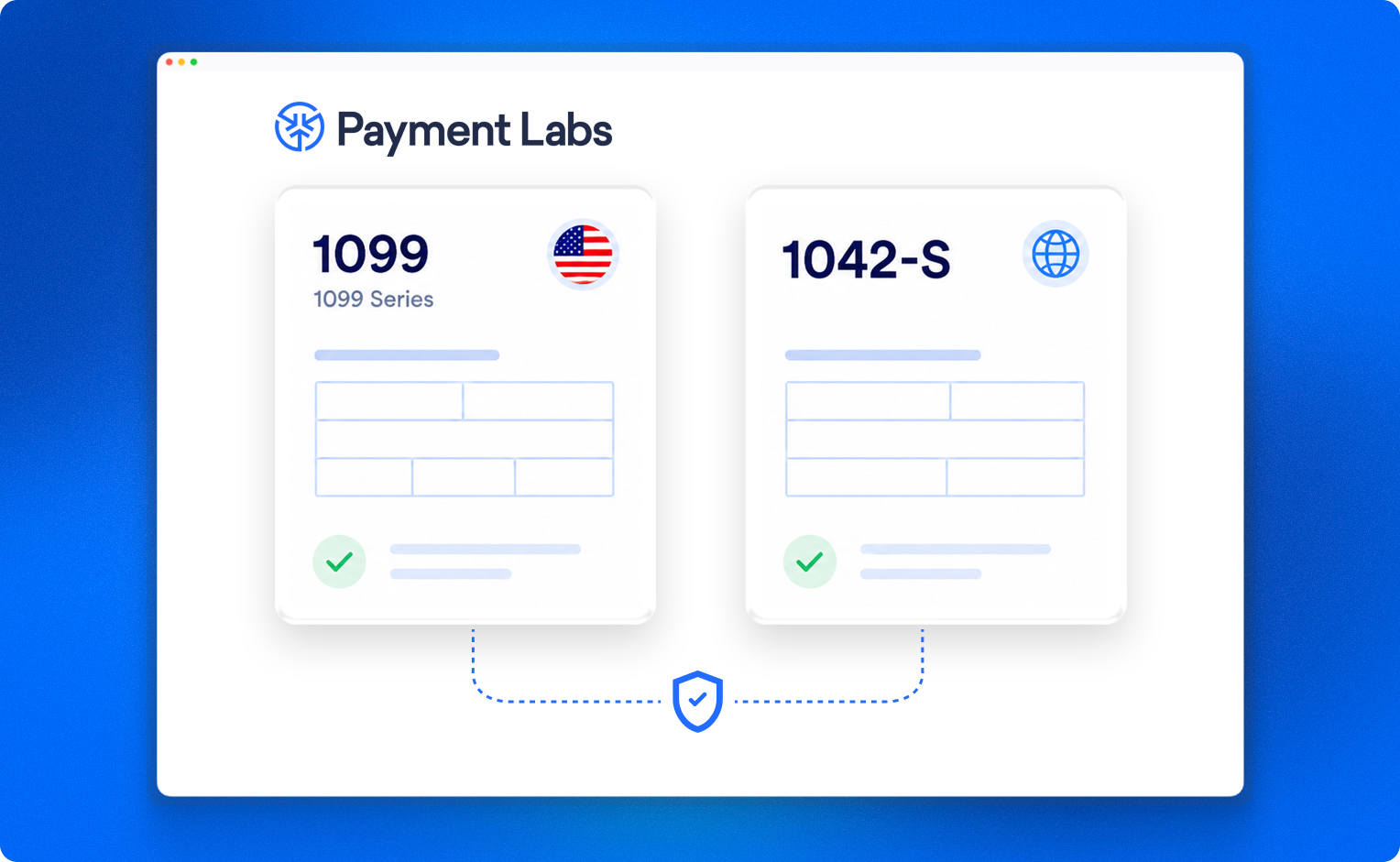
Forms 1099 and 1042-S are IRS information returns used to report certain payments made to nonemployees and other payees.
- For U.S. payees, businesses generally use the 1099 form series. For foreign payees, businesses may need to use Form 1042-S when reporting certain U.S.-source income paid to foreign persons.
- For businesses that pay international contractors, athletes, creators, prize winners, agencies, vendors, or other recipients, the reporting process usually starts before the payout is sent.
As a payer, you need to:
- collect the right tax documentation from payees, such as W-9 or the applicable W-8 form
- determine whether the payee is a U.S. person or foreign person
- classify the payment type correctly
- determine whether withholding applies
- track reportable payments by calendar year
- file the correct forms with the IRS
- furnish copies to recipients by the applicable deadline
- correct errors when information changes or IRS notices arrive
What you need to know about the 1099 form series
The 1099 form series covers many types of reportable payments, but most payout programs in sports, esports, NIL, creator, and contractor operations usually run into three forms: 1099-NEC, 1099-MISC, and 1099-K.
- 1099-NEC is used to report nonemployee compensation. For tax years beginning after 2025, businesses generally file Form 1099-NEC for reportable nonemployee compensation of $2,000 or more. This can include contractors, freelancers, service providers, and other reportable nonemployee payees.
- 1099-MISC is used for payments including royalties, prizes and awards, rent, and other income. Many 1099-MISC categories are reportable starting at $2,000. Royalties are generally reportable at $10 or more.
- 1099-K applies to payment card transactions and certain third-party network transactions. For third-party settlement organizations, reporting generally applies when a payee receives more than $20,000 in aggregate payments for goods or services and has more than 200 transactions in a calendar year. Payment card transactions are reportable regardless of amount.
To file Forms 1099, businesses generally need U.S. payees to provide a completed W-9 with their legal name, tax classification, and taxpayer identification number.
Payment Labs helps collect and manage tax documentation through a structured payout workflow instead of relying on manual form collection. For a deeper breakdown of domestic reporting, read our guide to 1099 compliance for athletes, agencies, and collectives.
Key filing deadlines for Forms 1099 and 1042-S
For most 1099 and 1042-S reporting, businesses deal with two deadlines: the deadline to deliver copies to recipients and the deadline to file with the IRS.
- 1099-NEC must be filed with the IRS and sent to recipients by January 31 or the next business day if the date falls on a weekend or legal holiday.
- 1099-MISC must be filed with the IRS by February 28 if filed on paper or March 31 if filed electronically. Recipient copies are generally due by January 31, although some 1099-MISC boxes have different recipient statement deadlines.
- 1099-K recipient copies are due by January 31. IRS filing is generally due by February 28 for paper filing or March 31 for electronic filing.
- 1042-S must be filed with the IRS and furnished to recipients by March 15 of the following calendar year, or the next business day if the date falls on a weekend or legal holiday. If you file Form 1042-S, you must also file Form 1042, Annual Withholding Tax Return for U.S. Source Income of Foreign Persons. Businesses required to file 10 or more information returns in a year generally must file electronically.
What you need to know about 1042-S reporting
Form 1042-S is used to report certain U.S.-source income paid to foreign recipients, along with any U.S. tax withheld. This can include certain U.S.-source payments to foreign contractors, athletes, artists, creators, prize winners, royalty recipients, or entities, depending on the source of income, payment type, and withholding rules. This matters when the same program pays U.S. recipients, foreign recipients, agencies, and prize winners through one payout operation.
Before making these payments, businesses have to collect the appropriate W-8 form (most commonly W-8BEN for individuals or W-8BEN-E for entities). This establishes the recipient’s foreign status and supports treaty claims or other withholding positions.
The default withholding rate for many types of U.S.-source income paid to foreign persons is 30%, unless an exemption, reduced treaty rate, or other rule applies. The payer may still need to file Form 1042-S even when no tax was withheld because of an exemption.
The 1042 reporting process can involve three forms:
- 1042-S: reports income paid to a foreign recipient and any tax withheld.
- 1042: annual withholding tax return used to report the total tax withheld on certain U.S.-source income of foreign persons.
- 1042-T: paper transmittal form used when submitting paper Forms 1042-S to the IRS.
Classifying payments before filing
Before filing Forms 1099 or 1042-S, businesses need to classify each payment by payee type, payment type, and withholding treatment.
- For U.S. payees, this usually means choosing the right 1099 form and box. Payments for services performed by nonemployees generally go on Form 1099-NEC. Prizes, awards, royalties, rents, and certain other payments generally go on Form 1099-MISC. The key distinction is whether the payment compensates someone for services or reports another type of income, such as prizes, royalties, or rent.
- For foreign payees, reporting usually runs through Form 1042-S when the payment is U.S.-source income paid to a foreign person. Form 1042-S uses income codes to identify the type of income being reported. The income code should match the payment type, while the rest of Form 1042-S should reflect recipient status, withholding treatment, exemption codes, and any treaty position.
This is why classification should happen before payouts are sent, not at the end of the year. For high-volume programs paying athletes, prize winners, contractors, creators, NIL participants, agencies, or international recipients, even small classification errors can turn into a large correction project.
Common 1042-S income codes for global payouts
For sports, esports, NIL, creator, and contractor payouts, common 1042-S income codes include:
- 11 - motion picture or television copyright royalties
- 12 - other royalties, including copyright, software, broadcasting, and endorsement payments
- 16 - scholarship or fellowship grants
- 17 - compensation for independent personal services
- 18 - compensation for dependent personal services
- 20 - compensation during studying and training
- 23 - other income
- 42 - earnings as an artist or athlete, no central withholding agreement
- 43 - earnings as an artist or athlete, central withholding agreement
Codes 42 and 43 are especially relevant for athlete and artist payments. Code 43 should only be used when the central withholding agreement process applies. Otherwise, artist or athlete earnings generally fall under Code 42.
What businesses should have on record before filing
Before filing Forms 1099 or 1042-S, businesses should have:
- the payee’s legal name and tax status
- a completed W-9 or applicable W-8 form
- taxpayer identification details, when required
- the payment amount and payment type
- recipient country and tax residency details
- withholding rate and treaty position, if applicable
- the correct reporting form, box, or 1042-S income code
- proof that recipient copies were sent on time
Common mistakes and penalties for incorrect 1099 and 1042-S filing
Most IRS penalties come from a few filing problems: late forms, missing forms, wrong payee information, incorrect TINs, missing recipient copies, or errors that are not corrected.
If the name and TIN on a Form 1099 do not match IRS records, the IRS may send a CP2100 or CP2100A notice, often called a B notice, asking the business to correct the issue. Businesses should also understand backup withholding rules when payee information is missing, incorrect, or not corrected on time.
Form 1042-S adds more risk because errors can also involve income codes, recipient status codes, exemption codes, withholding rates, treaty claims, or W-8 documentation.
As of 2026, the general penalties are:
- $60 per return or statement if corrected within 30 days after the due date
- $130 if corrected more than 30 days late, but by August 1
- $340 if corrected after August 1 or not filed
- $680 for intentional disregard, with no maximum.
These penalties can apply twice: once for the IRS filing and once for the payee copy.
For 2026 Form 1042-S, intentional disregard can trigger a penalty of the greater of $690 per form or 10% of the amount required to be reported, with no maximum.
To reduce risk, collect tax forms before payment, validate payee details early, classify payments correctly, send recipient copies on time, and correct errors quickly.
Managing Forms 1099 and 1042-S reporting
Manual tax reporting may work when a business only pays a small number of contractors or vendors. It becomes much harder when payout volume grows across athletes, prize winners, creators, contractors, agencies, NIL participants, and international recipients.
The hard part is not only filing the forms. It is collecting tax documentation before payment, validating payee information, classifying payment types, tracking withholding, keeping payout records organized, and issuing recipient copies on time. Businesses also need the right payout platform and a process for keeping payment records reconciled across systems, so tax documentation stays connected to the actual payout history.
Payment Labs helps businesses manage payout and tax documentation workflows for sports organizations, esports companies, NIL collectives, athletic departments, creator businesses, agencies, and other high-volume payers. Teams can collect payee information, support domestic and international recipients, manage payout records, and reduce manual tax documentation work through one structured process.
Talk to Payment Labs to reduce manual payout, tax documentation, and reporting work for your team and your payees.