Working with SEPA payments: SEPA transfers, countries, and instant payment rules explained
SEPA standardizes how euro payments move across participating jurisdictions. This guide explains the main SEPA payment schemes, clearing and settlement, access models, indirect participation, and the operational limits businesses need to know.

For companies moving euro payments across Europe, SEPA is what keeps those transfers from becoming a country-by-country payment project.
SEPA (Single Euro Payments Area) sets common rules for euro credit transfers, direct debits, and instant payments across participating countries and territories.
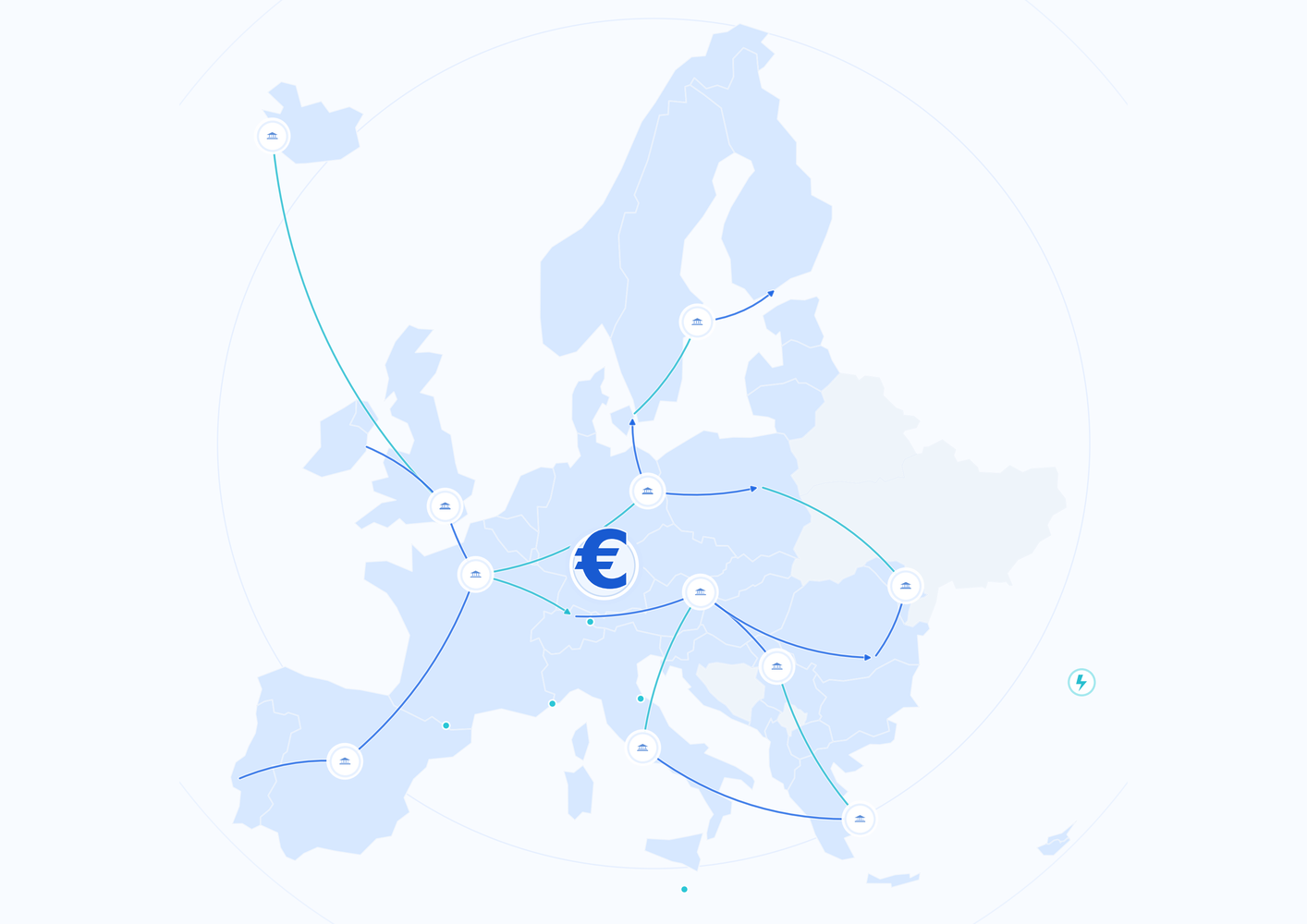
SEPA now includes 41 countries and territories, covering all EU member states as well as several non-EU markets. This allows businesses to use the same payment formats and schemes to reach more than 500 million people.
This guide explains how SEPA works, which countries participate, how payment schemes differ, what recent regulatory changes mean, and where businesses still need additional payment infrastructure.
What is SEPA
SEPA is a harmonized euro payments area supported by common payment schemes, technical standards, legal rules, and clearing and settlement infrastructure.
It’s built to make any euro payment between SEPA accounts as straightforward as a domestic payment, whether the parties are in the same country or different SEPA jurisdictions.
SEPA is broader than the euro area and broader than the European Union. It includes countries that use the euro, EU countries that still use their own currencies, and several non-EU jurisdictions that participate in SEPA schemes.
The European Payments Council manages the main SEPA payment schemes, while European institutions, national authorities, banks, payment institutions, electronic money institutions, and clearing and settlement systems all play a role in how SEPA payments operate in practice.
Understanding SEPA payment schemes
SEPA payments usually fall into two categories: credit transfers and direct debits. Credit transfers push money from one account to another. Direct debits let an authorized payee collect funds from a payer’s account. Here are the main schemes:
- SEPA Credit Transfer (SCT) is the standard euro bank transfer scheme. It is used for supplier payments, refunds, payouts, and other account-to-account transfers.
- SEPA Instant Credit Transfer (SCT Inst) is the instant version of SCT. It is designed to make euro payments available within seconds, including outside normal banking hours.
- SEPA Direct Debit Core (SDD Core) is used to collect euro payments from consumers and, in some cases, businesses. It is common for recurring bills, subscriptions, and invoice collections.
- SEPA Direct Debit Business-to-Business (SDD B2B) is built for collections between businesses. It has different mandate and refund rules, so it is not used the same way as SDD Core.
The European Payments Council also supports newer schemes and services around SEPA payments, including SEPA Request-to-Pay, Verification of Payee, and One-Leg Out Instant Credit Transfer. This addresses challenges like payment requests, account-name checks, and international instant credit transfers where the euro leg is processed through SEPA infrastructure.
SEPA instant payments update
Instant euro payments are moving from optional capability to expected infrastructure across the EU and EEA.
Regulation (EU) 2024/886 introduced new requirements for instant euro credit transfers, including deadlines for when payment service providers must be able to receive and send instant payments.
Euro-area payment service providers were required to receive instant euro payments by January 9, 2025, and send them by October 9, 2025. The regulation also requires instant payments to cost no more than comparable standard credit transfers. The rollout is staggered for non-euro area member states, payment institutions, and electronic money institutions, with later deadlines in 2027. Some requirements for payment accounts denominated in national currencies in non-euro area member states extend into 2028.
Verification of Payee and SEPA fraud prevention
A wrong name or mismatched IBAN can slow down a SEPA payment before it leaves the sender’s account. Verification of Payee (VoP) is designed to reduce that risk by checking the recipient name against the payment account identifier, usually the IBAN, before a SEPA credit transfer/instant credit transfer is sent.
For example, if a business tries to pay an organization but the account is registered under a different legal name, the payer may see a match, close match, no match, or another result before confirming the transfer.
How SEPA payments work: clearing and settlement
A SEPA payment typically starts with the payer’s bank or payment service provider. From there, the payment details are validated, formatted under the relevant SEPA scheme, and sent through a clearing and settlement mechanism. Settlement may happen through Eurosystem services such as T2 or TIPS, or through private-sector infrastructure involving banks, payment service providers, correspondent banking relationships, or sponsored access models.
In practice, the business usually sees only the front end of this process: the payment is submitted, validated, tracked, and either completed or returned. The routing and settlement work happens behind the scenes. In a simplified SEPA credit transfer flow:
- A customer or business initiates a euro payment with their bank or payment service provider.
- The payer provides the recipient’s name, IBAN, payment amount, and any required reference information.
- The payer’s provider validates the payment details, checks reachability, applies required compliance controls, and formats the message using ISO 20022 standards, the same standard used by SWIFT.
- The payment instruction is exchanged through a clearing and settlement mechanism.
- The participating institutions settle the funds.
- The recipient’s provider credits the account and returns the relevant payment status information.
How to start processing SEPA payments
There are three common ways for companies to access SEPA payments:
- Use a bank or payment service provider - this is the simplest option for most businesses. The provider handles scheme participation, connectivity, compliance requirements, payment formatting, settlement, and reporting.
- Work through a correspondent or sponsor bank - this can give a business or payment company access to SEPA functionality through a regulated institution already connected to the relevant schemes.
- Become a direct or indirect scheme participant - this gives more control, but it also creates more operational, technical, regulatory, compliance, and reporting responsibility.
Corporate bank customer vs. indirect SEPA participant
Most companies access SEPA as corporate customers of a bank or payment service provider. In this model, the provider handles the connection to SEPA schemes, payment formatting, clearing, settlement, compliance workflows, returns, recalls, and reporting.
As an indirect SEPA participant, a payment company can send and receive SEPA credit transfers, direct debits, and instant payments under a sponsor bank or other approved access arrangement.
Indirect participation can support more control over routing, reconciliation, payment status messages, settlement reporting, safeguarded accounts, recalls, returns, and exception handling. But it also requires stronger operations, compliance, AML, sanctions screening, fraud controls, technical integration, and sponsor-bank oversight.
Importance of the SDD (SEPA Direct Debit) mandate
A SEPA Direct Debit mandate is the authorization that allows a payee to collect funds from a payer’s account.
The mandate records the payer’s consent, payment account details, creditor information, mandate reference, and other required data. Businesses that collect SEPA Direct Debit payments need to store mandates securely, keep records available, and manage changes, cancellations, disputes, and refunds.
This is especially important for recurring payments, subscriptions, memberships, invoices, and B2B collections because errors can lead to failed payments, disputes, refund requests, or compliance issues.
Countries and territories where you can make SEPA payments
Jurisdictions participating in SEPA include all 27 EU member states, plus the United Kingdom, Iceland, Norway, Liechtenstein, Switzerland, Monaco, San Marino, Andorra, and Vatican.
The SEPA area also includes Montenegro, Albania, North Macedonia, Moldova, and Serbia.
Eligible local institutions from newly included countries may still need to complete operational readiness and scheme adherence steps before SEPA payment services are broadly available.
SEPA is not the same as the eurozone. Some SEPA countries use the euro. Others use a local currency but participate in SEPA for euro payments.
Examples of SEPA countries that do not use the euro as their national currency include Denmark, Sweden, Poland, Czechia, Hungary, Romania, Iceland, Norway, Liechtenstein, Switzerland, and the United Kingdom.
SEPA payments are euro-denominated. If a business is sending money to or from an account in another currency, conversion may still be required outside the SEPA payment itself.
Businesses should also remember that IBAN support does not automatically mean SEPA reachability. Some countries use IBANs but are not part of the SEPA schemes, so this should be checked before building a payment flow around a specific market.
SEPA vs SWIFT
The practical question is usually simple: is this a euro payment between reachable SEPA accounts, or does it involve another currency, non-SEPA country, or correspondent banking chain?
SEPA and SWIFT are often mentioned together, but they serve different purposes.
- SEPA is a set of euro payment schemes and standards used for account-to-account payments across participating European countries and territories. It is designed for euro credit transfers, euro instant payments, and euro direct debits.
- SWIFT is a global financial messaging network used by financial institutions around the world. It can support many currencies, countries, banks, and correspondent banking relationships.
SWIFT becomes more relevant when the payment involves another currency, a non-SEPA country, or multiple intermediary institutions.
The importance of SEPA in the European and global financial ecosystem
For businesses, the main value of SEPA is standardization.
A business still needs a bank, payment provider, or payment platform. But the underlying schemes make it easier to use common payment formats, IBAN-based account details, payment status messages, and direct debit rules across participating markets.
Instead of building separate euro payment workflows market by market, companies can use common payment schemes, IBAN-based account details, ISO 20022 messaging, and standardized payment rules across the SEPA area.
But while SEPA simplifies euro payments, it does not remove the surrounding operational work.
Companies still need to onboard recipients, verify identities, screen payments, collect tax documentation and distribute forms, track payout status, handle failed payments, and support recipients across markets.
Payment Labs helps sports organizations, esports companies, creator businesses, agencies, platforms, and other high-volume payers manage the operational layer around global payins and payouts with more visibility and less manual effort.
Talk to Payment Labs to build a payment workflow that can scale across markets.